

Executive Summary
Leadership and innovation aren't separate disciplines – they're two sides of the same coin. The most successful organisations don't just have creative teams; they have leaders who create the conditions where innovation thrives. This requires shifting from finite thinking (protecting what you have) to infinite thinking (continuously evolving), building psychological safety with accountability, and developing the discipline of regular reflection. Companies like WeWork and Theranos failed not because they lacked innovative ideas, but because their leadership cultures killed the very innovation they needed. The path forward is clear: leaders must become innovation enablers, creating environments where curiosity, experimentation, and intelligent risk-taking become organisational reflexes.
Why Leadership Needs Innovation to Thrive
When I tell someone I'm a Leadership Consultant, they understand instantly. Say I'm a Leadership and Innovation Consultant and the response is usually a puzzled look, glazed eyes, or a hopeful question about whether I can fix their computer.
The reaction tells you everything about how we think about these two concepts. Leadership feels concrete - we can picture what good leaders do. Innovation feels abstract, almost mystical. We treat them as separate domains: leaders over here making decisions, innovators over there having breakthrough moments in labs with oodles of sticky notes.
What over a decade of working with organisations has taught me, is that the most innovative companies aren't led by the most creative CEOs. They're led by leaders who understand that innovation isn't a department or a process - it's what happens when you create the right conditions for human curiosity and courage to flourish.
This became crystal clear during Australia's 'Ideas Boom' era. Malcolm Turnbull announced the initiative, accelerators sprouted everywhere, and every large organisation wanted in. Yet the companies that actually innovated weren't those with the flashiest labs or biggest R&D budgets. They were those whose leaders cracked the code on something much more fundamental: you can't have sustainable leadership without innovation, and innovation won't survive without the right leadership.
Consider WeWork, whose leaders had genuinely innovative co-working concepts but created a culture of high ego and low psychological safety where questioning the vision was career suicide. Billions in valuation evaporated because innovation couldn't survive in an environment where only the founder's ideas mattered. Or look at Theranos - Elizabeth Holmes created such a culture of fear that employees were siloed to prevent them from seeing the full picture, and questioning the technology was forbidden. The very innovation in testing and validation that could have made their vision real was systematically crushed by leadership that couldn't tolerate dissent. These weren't failures of technology or market research - they were failures of leadership to create the conditions where innovation could actually thrive.
The stakes remain just as high today…
Innovation Skills are Leadership Skills
Leadership and innovation aren't separate disciplines - they're two sides of the same coin. When leaders demonstrate curiosity about new ways of thinking and working, they create permission for possibility. When they don't, teams quickly learn that difference is dangerous, so they play it safe and innovation dies a quiet death.
The qualities most often linked to innovation - creativity, critical thinking, customer focus, and a willingness to experiment – are also the hallmarks of great leadership. In complex, fast-changing environments, these aren't 'nice to have' extras; they're survival skills.
Harvard researcher Linda Hill, author of Collective Genius, puts it perfectly:
"Your role must be to create an environment – a setting, a context, an organisation – where people are willing and able to do the hard work of innovation themselves: to collaborate, learn through trial and error, and make integrated decisions."
Leaders don't need to have all the ideas. Their job is to create the space where ideas can thrive. That requires humility, curiosity, and trust - qualities that sit in direct opposition to traditional command-and-control leadership.
Netflix exemplifies this beautifully. Rather than dictating every decision from the top, their leaders created a culture where employees are trusted to make significant choices - including spending decisions worth millions. This approach enabled them to pivot from DVD-by-mail to streaming to content creation, always staying ahead of industry shifts. Their leadership philosophy of "freedom and responsibility" shows how creating space for innovation at every level drives sustainable competitive advantage.
The Infinite Game: Leadership for the Long Term
This approach connects to a fundamental question every leader must answer: Are you playing to win, or playing not to lose?
Walk into most boardrooms and you'll see leaders obsessing over protecting market share, avoiding risks, and defending existing revenue streams. It feels prudent, but it's actually a trap - what James Carse called a finite game, where the goal is simply not to lose. The alternative is the infinite game: where success means staying in play long enough to keep evolving, adapting, and creating value.
Innovation lives in the infinite game. It's how you change before change forces your hand.
The shift from finite to infinite thinking starts with a hard look at your relationship with control. Finite-game leaders hoard decisions because making choices gives them that hit of immediate certainty. Infinite-game leaders get their satisfaction differently - from watching their people grow, from seeing ideas emerge they never could have conceived themselves, from building something that outlasts their tenure.
Consider how this plays out in practice. A finite-game leader keeps all strategic decisions close, even when their team knows the customers better. They get the dopamine hit of being "the decider," but progress crawls and people check out. An infinite-game leader asks a different question: "What's the smallest number of decisions I actually need to make?" They push everything else down to the people closest to the action. Sure, some decisions won't be perfect, but the momentum and ownership created far outweigh the occasional misstep.
Creating a Culture Where Innovation Thrives
Building this level of trust requires what Amy Edmondson calls psychological safety - the belief that you can speak up without fear of ridicule or retribution. When people feel safe enough to ask "what if?" and challenge assumptions, ideas flourish naturally.
But here's where most organisations get it wrong. Psychological safety isn't about making everyone comfortable all the time. It's not about avoiding conflict or challenge. What it excludes is personal agendas, retribution, and mockery.
I saw this play out with an organisation that completely misunderstood the concept. They thought psychological safety meant acting like a family and avoiding all conflict. Leaders took pride in how comfortable everyone felt and bent over backwards to keep things caring and supportive.
The result? A culture where employees felt equally comfortable complaining when things got tough, but rarely took ownership when things went wrong. Side conversations like "I knew that would never work when they first suggested it" became routine. Yet these same people were never held accountable for staying silent when their insights could have actually helped. They'd created a culture of comfort, not courage.
True psychological safety must be matched with collective accountability. Otherwise, you risk creating a culture where people enjoy coming to work but never stretch themselves, contribute ideas, or collaborate across boundaries.
The leader's role is balancing psychological safety with a shared commitment to the organisation's vision and goals. When you get this balance right, innovation stops being a program and becomes a reflex. Teams no longer wait for permission, they act like owners.
Reflection: The Leadership Habit That Drives Innovation
Creating a balance between psychological safety and accountability doesn't develop automatically - it requires deliberate cultivation through regular reflection. One of the biggest traps for leaders is assuming that "what worked yesterday will work tomorrow."
If you're not regularly asking "What assumptions am I holding? What needs to change?", you're not standing still, you're falling behind. Leaders who build in reflection, both personally and with their teams, consistently make better decisions and lead more effectively. It's not indulgence; it's a discipline that separates thriving organisations from struggling ones.
The reflection process can be remarkably simple. Start with four fundamental questions: What worked well? What didn't work well? What would we do differently in the future? What feedback am I seeking from others, and what would I give myself? These questions, asked consistently, create the learning loops that drive both personal growth and organisational innovation.
Getting Started: Your Next All-Hands Meeting
Want to put this into practice immediately? At your next all-hands meeting, try this: have groups explore what in your system is currently holding them back from innovating. Ask them to identify three types of barriers: personal barriers, system barriers, and barriers created by leadership.
This exercise will give you invaluable insight into where you can make significant and meaningful change. More importantly, it signals to your team that you're serious about creating space for innovation and that their input matters. You might be surprised by what you discover - and how quickly people start thinking like owners when they see their feedback being acted upon.
Uniting Leadership and Innovation for Lasting Impact
Leadership today isn't about having all the answers. It's about creating the conditions for progress through curiosity, courage, and adaptability. When leaders model this, innovation follows as naturally as night follows day.
That's why leadership and innovation can't be separated. They're partners in the truest sense; one strengthens the other, and together they shape the future. The organisations that thrive won't be those with the smartest leaders or the most creative teams. They'll be those where leadership and innovation work in harmony, creating environments where both people and ideas can flourish.
Maybe innovation isn't so puzzling after all. Maybe it's just leadership by another name. Leadership that's brave enough to let go, curious enough to keep learning, and wise enough to know that the best ideas often come from everywhere except the corner office.
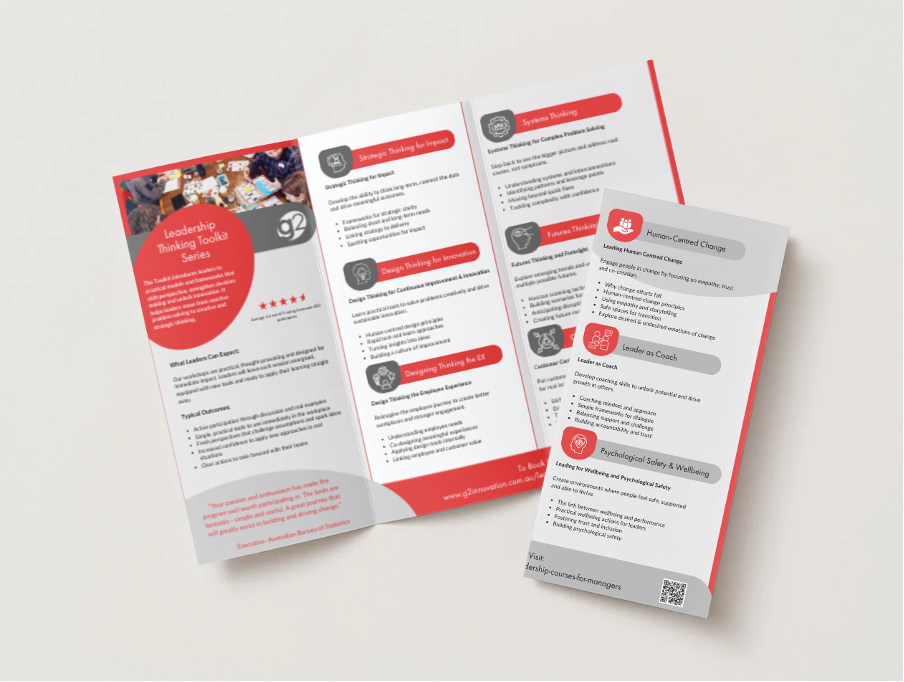
Uplift your Innovation and Leadership Skills
Get our full workshop guide and discover actionable, ready-to-run courses for leaders and teams.