
What Great Leadership Looks Like Today: The 10 Essential Qualities
Leadership is not a fixed state.
It is a practice, one that demands as much of our inner world as our outward actions. In today’s turbulent and unpredictable environment, the qualities of a great leader are less about technical know-how and more about who you are, how you show up, and how you help others find their own footing.
Having worked with leaders at every level, through crises, restructures, missed opportunities, and those rare days when everything comes together - what stands out isn’t charisma or heroics. It’s the everyday choices. It’s the willingness to be seen, to listen, to change course, and sometimes, to get out of the way.
Below, I offer my own take on what makes a truly great leader. These are not boxes to be ticked, nor are they reserved for those with certain titles or a corner office. They are qualities to be practised, grown, and refined over a lifetime.
A Personal Reflection: When Leadership is Tested
A while ago, I found myself facing disappointment on two fronts in the space of a week. At the start of the weekmy daughter felt the sting of being rejected for a coveted role at school; by Friday, my team and I narrowly missed out on a significant tender opportunity. I won’t pretend - both hurt.
My daughter’s reaction was beautifully raw and honest. She had a good cry, spent the evening wallowing, and confessed her biggest fear: what would other people think? By morning, she had gathered herself and told me, quite matter-of-factly, “Everyone gets more no’s than yes’s in life,” before setting her sights on the next challenge.
As for myself, I found comfort in sharing my feelings with a trusted colleague, took a walk to clear my mind, and, after a moment of throwing my own “teddies out of the pram,” shifted into a mindset of learning and growth. Reflecting on these moments, I realised they encapsulate so many of the qualities I see in great leadership: resilience, vulnerability, self-awareness, and the willingness to move forward, not in denial of disappointment, but because of what we’ve learned from it.
The 10 Qualities of a Great Leader
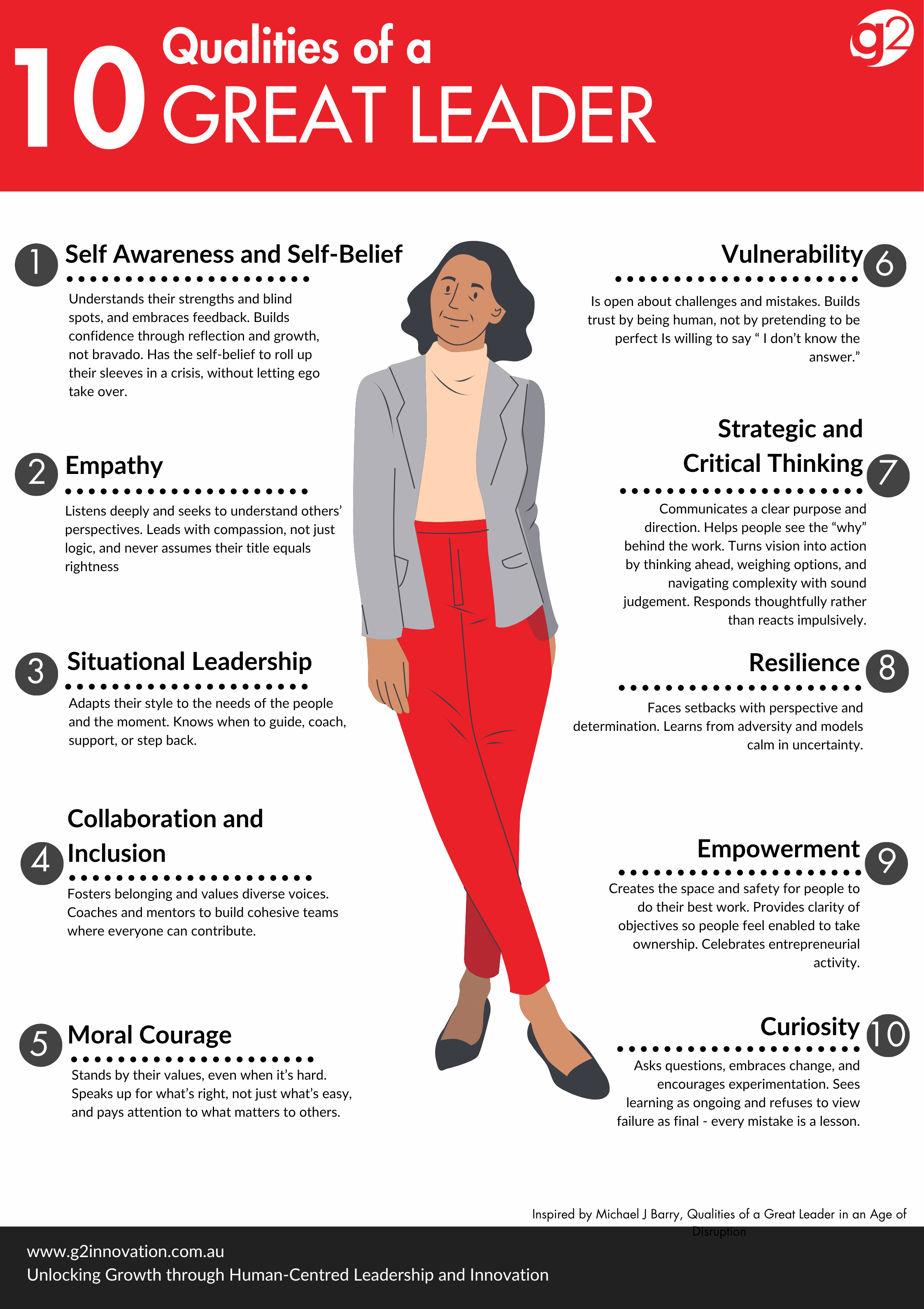
Self-Awareness & Self-Belief
The best leaders know themselves. They are honest about their strengths and weaknesses and welcome feedback as an opportunity for growth rather than a threat to their authority. True self-belief is not loud or showy; it’s grounded in reflection and the quiet confidence to roll up your sleeves in a crisis, without ego taking over. In moments of uncertainty, this kind of self-awareness allows leaders to step in when needed, and to step back when others are better placed to act.
Vulnerability
It takes strength to be vulnerable, especially in a world that often prizes certainty and bravado. Great leaders share their challenges and mistakes openly, making it safe for others to do the same. Vulnerability is not about oversharing or seeking sympathy; it’s about demonstrating that you’re human, and in doing so, building trust across your team.
Download your copy of the Infographic
Situational Leadership
There is no one-size-fits-all approach. The ability to adapt - to flex your style according to the needs of your people and the moment - is the hallmark of effective leadership. Sometimes it means guiding with a steady hand; sometimes it means coaching, supporting, or simply getting out of the way. Great leaders read the room and adjust their approach, recognising that what got them here may not get them there.
Empathy
True empathy goes beyond listening to the words. It’s about seeking to understand others’ perspectives and leading with compassion as well as logic. The best leaders never assume that their title equates to rightness. They foster a culture where everyone’s voice matters and where decisions are made with people, not just processes, in mind.
Curiosity & Learning Mindset
If you want to grow a resilient, innovative organisation, curiosity is non-negotiable. Leaders who ask questions, embrace change, and encourage experimentation are the ones who adapt and thrive. Crucially, they reject the notion of failure as a dead end. Instead, mistakes become lessons, an ongoing opportunity to learn and improve.
Strategic & Critical Thinking
Setting a clear direction is only half the battle. Great leaders translate vision into action by thinking ahead, weighing options, and navigating complexity with sound judgement. They bring clarity to the chaos, help people understand the “why” behind the work, and make decisions that are responsive, not simply reactive.
Resilience
Setbacks are inevitable, but how you respond makes all the difference. Resilient leaders face adversity with perspective and determination. They model calm when others are rattled and demonstrate that setbacks are not endpoints, but opportunities to regroup and try again.
Empowerment
Empowering others isn’t just about delegation. It’s about creating the space and safety for people to do their best work, providing clarity of objectives, and then trusting them to deliver. Great leaders celebrate entrepreneurial spirit and encourage ownership at every level, knowing that people thrive when given both freedom and responsibility.
Moral Courage
Standing by your values is never easy, particularly when the stakes are high. Leaders with moral courage speak up for what’s right, not just what’s easy. They listen deeply to what matters to others and are willing to take a stand, even when it means facing discomfort or opposition. In doing so, they set the tone for integrity throughout the organisation.
Collaboration & Inclusion
No leader succeeds alone. The strongest organisations are built on a foundation of collaboration and inclusion. Great leaders foster belonging, value diverse perspectives, and act as coaches and mentors to build cohesive teams. When everyone is encouraged to contribute, the collective intelligence of the organisation rises.
In summary:
Great leadership is not about having all the answers, or always getting it right. It’s about staying open, resilient, and focused on the growth of yourself, your people, and your purpose. These qualities are not innate gifts; they are choices, made moment by moment, that over time shape the culture and direction of your team.
As the world shifts, so must we. The best leaders are those who never stop learning, who can balance clarity with curiosity, and who lead with both courage and care. If you’re working on even half of these qualities, you’re on the right track.
Want to boost your team’s leadership skills? Our Leadership Programs could be the answer.