
Why Critical and Creative Thinking are still the Real Competitive Edge
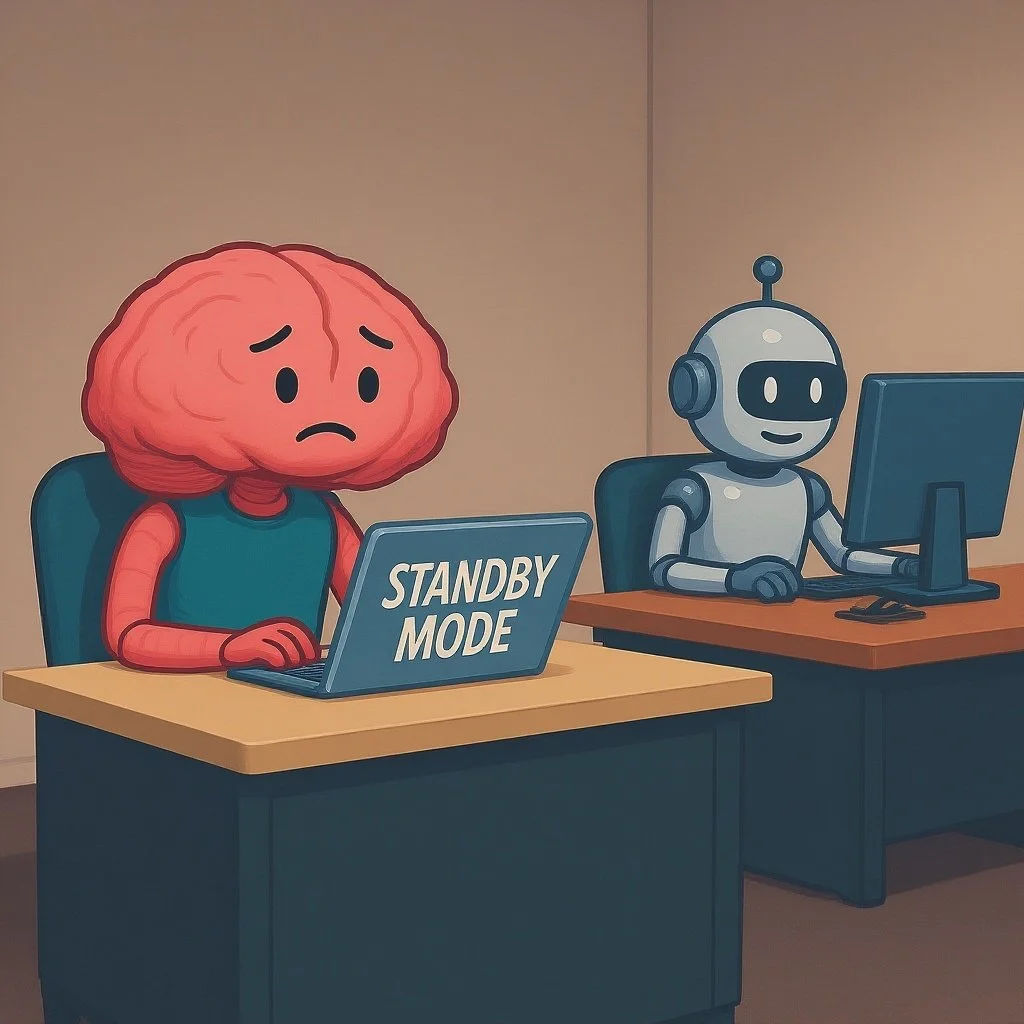
A recent study from MIT has sparked a lot of debate, suggesting that relying on AI tools such as ChatGPT might blunt our cognitive sharpness. Lower brain activity, foggier memory, and a dip in originality.
But, it raises a bigger, more unsettling question: Would we even know if it was happening?
If we’re not actively practising critical and creative thinking, how would we spot the signs that our cognitive muscles are starting to weaken? And how do we ensure that AI becomes an amplifier of our intelligence, rather than a quiet substitute for it?
Now, more than ever, we need to nurture the very human skills that keep us sharp, adaptive, and innovative.
1. The Real Risk Isn’t AI - It’s Unthinking Dependence
Not long ago, I received an email from someone I know and respect. Except, in many ways, it wasn’t from them at all.
It was obviously generated by AI: smooth, efficient and technically well-written, but utterly stripped of the warmth and nuance I’d come to expect from this person. It didn’t connect on a human level. Instead, it felt cold and transactional, like a piece of output rather than genuine communication.
That’s the real risk. Not that AI is too clever, but that we become too passive in how we use it. When we let AI handle our thinking or our communication without discernment, we risk losing the human qualities that make our relationships and our ideas so powerful.
2. Critical Thinking: Our Cognitive Compass
Critical thinking is our cognitive compass. It’s how we navigate the flood of AI-generated content, sifting what’s useful from what’s biased, superficial or simply wrong.
A recent example says it all. In May 2025, the Chicago Sun-Times published a summer reading feature created by a third-party partner, which turned out to be AI-generated and completely unverified. It included, amongst other things, fake book titles. The piece only came down after humans flagged the errors.
It’s a stark reminder that without human scrutiny, AI-generated material can slip through and be mistaken for legitimate work.
I’ve seen this closer to home. In a co-design session, where we were refining organisational values. Someone who was new to this type of work tried using AI to tidy up the wording. The result was neat and tidy but completely lacked the depth and authenticity we were aiming for.
Having done this work many times, I know the real value lies not in elegant phrasing, but in making sure every word reflects the culture we aspire to create. Now, whether AI would be capable of better and the lack of the good prompt was to blame, makes no real difference to my argument. The outcome still revealed a lack of critical thinking on behalf of the human. And without it, it’s easy to accept AI’s output without asking whether it’s truly fit for purpose.
3. Creativity, Empathy, and the Human Edge
AI can remix existing ideas in fascinating ways. It can even produce work that looks creative at first glance. But creativity - goes deeper than clever wordplay or novel combinations of concepts.
Consider empathy. AI can analyse sentiment, scan thousands of reviews, and spot patterns in language. But can it truly understand the raw emotion, the subtle tensions, or the unspoken concerns that humans notice by simply being in the room? The look in someone’s eyes, the hesitation in their voice, the quiet shift in posture.
In human-centred design, we rely on these clues to uncover real pain points and shape solutions that resonate deeply. AI can help us organise and synthesise information, but the spark of human empathy is what makes innovation meaningful.
And when it comes to disruptive thinking, yes, AI can produce fresh outputs, but only if we know how to ask the right questions. Creativity isn’t just about generating ideas; it’s about framing problems, exploring possibilities and guiding AI with genuine insight.
If we lose our ability to think critically and creatively, we lose our power to guide the very tools that are supposed to help us.
Augmentation, Not Automation
The future doesn’t belong to humans or to AI alone. It belongs to humans who know how to think deeply, create boldly, and use AI as a partner that multiplies their talent.
The real competitive advantage will belong to people and organisations who can:
Spot when AI’s outputs fall short of human nuance and authenticity
Apply critical thinking to question, refine and improve what AI produces
Bring empathy and creativity to problem-solving and innovation
Keep asking better questions - and not stop asking them
Believe enough in their own intelligence, to challenge AI’s output.
A Fork in the Road
I used to think that we were standing at a fork in the road, where one path leads to using AI and the other more traditional paths. AI appeared to me, the better path. Now, as AI-as-the-default begins to take hold, I am realising that one path leads to outsourcing our thinking and slowly losing our capacity for intellectual rigour. The other leads towards augmentation, where AI becomes a powerful partner, helping us go further than we could alone.
The difference comes down to one thing: our willingness to keep investing in the skills that make us human.
Perhaps, the biggest competitive advantage won’t be your workforce’s AI capabilities, but your workforce’s capability in critical thinking, creative thinking and effective communication.
Because the real danger isn’t that AI might make us less intelligent. It’s that we’ll stop noticing when it does.
To avoid losing your edge, take a look at our critical thinking and innovation programs here