
I saw a post on LinkedIn and it triggered something in me. Accompanied by this image, it said:
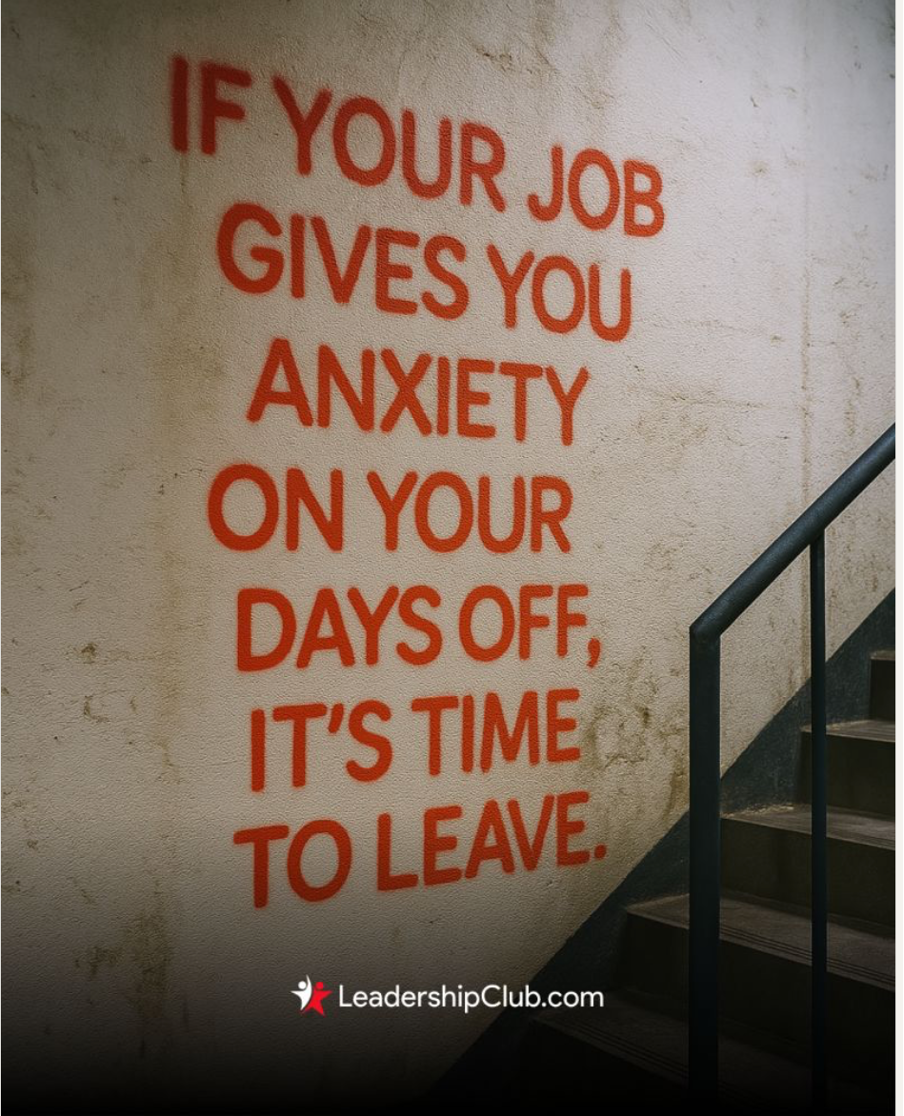
“Your job shouldn’t ruin your weekend
Here are 5 signs it already is:
1. You dread Sunday nights.
That sinking feeling means something’s off.
2. You check emails constantly.
Even on days off, you can’t switch off.
3. You can’t sleep before work.
Your body feels the stress before your mind does.
4. You get short-tempered at home.
The pressure spills into your personal life.
5. You feel trapped, not challenged.
There’s no growth, only survival.”
On the surface, it’s empowering. Boundaries matter. We aren’t responsible for other people’s behaviour. But something about it didn’t sit right. It felt like it was simplifying a complex human experience down to a slogan and some simplified ideas that are biassed against the workplace. I shared my discomfort in the comments, but then someone responded with a sharp rebuke. Their comment made me pause. Made me ask myself - had I missed the point?
So I sat with it. Thought about the times I’ve walked away from roles, relationships, opportunities. Sometimes because the environment was toxic, and staying would have cost too much. Other times because I was uncomfortable with my own growth edge, and it was easier to label the situation as broken than to look at what was being revealed in me.
And that’s when it hit me.
This isn’t a binary. It’s a both/and.
Sometimes, the wisest thing we can do is leave.
And sometimes, the most transformative thing we can do is stay and do the inner work. To ask: What am I bringing to this? Is anyone requiring me to check my emails, or am I choosing this path? Have I created an expectation? What am I avoiding by blaming them? Is this friction calling me to grow, or telling me to go?
The danger with oversimplified messages (however well-meaning) is that they can offer temporary clarity at the expense of long-term growth. They invite us to outsource the problem, when the most meaningful change usually starts within.
This reflection isn’t just personal. It has big implications for leadership, culture and innovation too.
Because when we’re too quick to walk away from the discomfort; of conflict, of feedback, of feeling out of our depth, we also walk away from the very conditions that breed insight and innovation.
In innovation work, we often say “fall in love with the problem.” But that only works if we’re willing to see that sometimes we are part of the problem. Not in a self-blaming way. But in a curious, courageous way.
Do we create spaces where disagreement leads to dialogue, not distance?
Do we hold up the mirror, or just point the finger?
Do we model the self-awareness we wish others had?
Innovation demands we stay with the tension long enough to let something new emerge. That’s true in teams. It’s true in culture. And it’s certainly true in leadership.
So yes, set boundaries. Walk away when you need to. But before you do, ask yourself the harder question:
What’s mine to see here?