
And why Innovation Needs It More Than Ever…
In a recent leadership session, participants were asked a simple question.
What leadership style do you most aspire to embody?
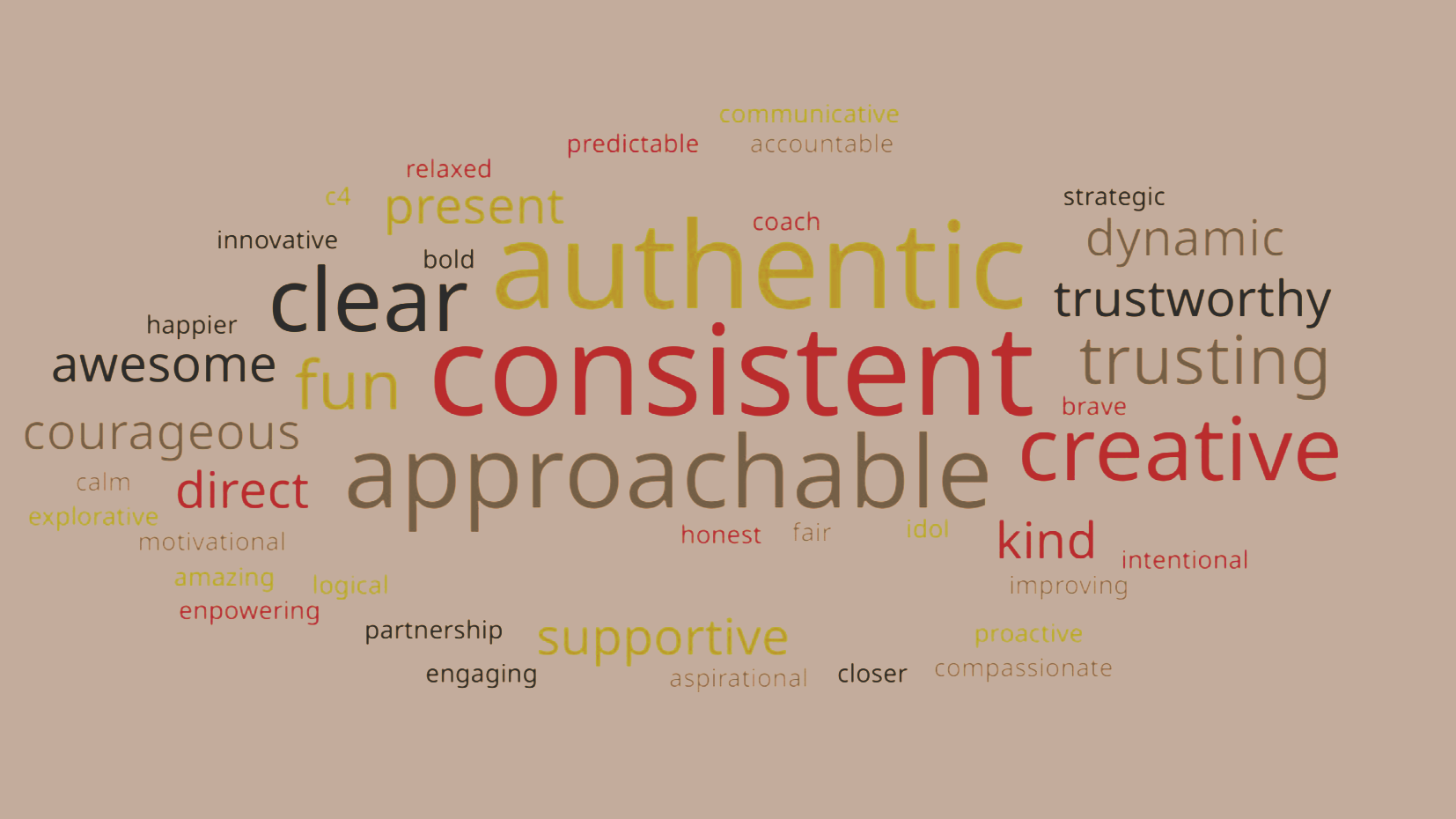
The responses were turned into a live word cloud. The kind that usually fills up with words like visionary, bold or inspiring.
But this one landed differently.
The word that rose to the top, by a clear margin, was consistent.
It sat there, large and unmistakable, followed closely by authentic and approachable. The message from the room was clear. In a world of increasing complexity, pressure and change, people are craving steadiness in their leaders more than spectacle.
Consistency, it seems, is quietly becoming more valuable than ever.
In many ways, it makes sense. When leadership behaviour is inconsistent, teams feel it immediately.
Priorities shift without warning. Feedback lands differently depending on the day. Decisions get revisited or reversed. Energy that could be spent on meaningful work gets redirected into reading the room.
People start asking themselves quiet questions:
Is now a good time to raise this?
Will this still matter next week?
Is this safe to act on?
Over time, this unpredictability creates cognitive load and emotional fatigue. It erodes trust, not through dramatic failure, but through subtle instability.
Consistency has the opposite effect.
It signals reliability. It creates clarity around expectations. It reduces emotional guesswork. It allows people to relax their shoulders and focus on contributing rather than protecting themselves.
This is why consistency is becoming so closely linked to psychological safety. Not because leaders are soft, but because they are steady.
But What About Innovation, Creativity, Bold Thinking?
This is where the conversation gets interesting.
While consistency resonates strongly in leadership and operational environments, it can feel far less appealing in creative and innovation spaces.
For innovators, designers and entrepreneurial thinkers, consistency can sound suspiciously dull.
It is often associated with governance, process, structure and predictability. All things that feel, at first glance, like they might blunt originality or slow momentum.
Creative environments thrive on movement. Sudden pivots, evolving ideas and unexpected connections generate energy. A certain level of chaos can even feel productive because it signals that thinking is alive.
So it raises a natural tension.
If consistency is so valuable for teams, does it come at the cost of creativity? The answer. Only if you let it.
The tension exists because consistency is often mistaken for sameness, but innovation does not suffer from consistent leadership. It suffers from inconsistent environments.
Creative teams do not need leaders to be predictable in their thinking. They need leaders to be predictable in how the environment around the thinking is held.
They benefit from consistency in areas such as:
Vision and purpose
Strategic priorities
Decision-making criteria
Access to resources
Sponsorship of experimentation
Psychological safety
When these foundations are steady, creative work accelerates rather than stalls.
Consistency, in this sense, is not the enemy of innovation. It is the infrastructure that supports it.
In our experience, high-performing innovation cultures tend to operate across two layers at once.
The first is creative freedom. This is where exploration lives. Ideas collide, evolve and sometimes fail. Experimentation is encouraged and divergent thinking is the norm.
The second is leadership consistency. This is where stability lives. Direction is clear. Guardrails are understood. Support is reliable. Decisions follow a transparent logic.
When both layers are present, innovation thrives.
But when creative chaos exists without leadership steadiness, the environment begins to feel unsafe rather than energising. Ideas stall, not because people lack imagination, but because they lack clarity about where imagination can go.
Creative risk-taking requires a structural safety. So to does BAU-making.
Workplaces today are navigating constant change. Shifting markets, new technologies, evolving workforce expectations and ongoing pressure to adapt.
In this environment, consistency becomes a stabilising force. Not like concrete that’s immoveable, but solid earth which feels grounding.
It doesn’t eliminate uncertainty, it provides something solid to stand on while navigating it.
This applies just as much in innovation environments as it does in operational ones.
Even the most creative minds do their best work when the ground beneath them is steady.