
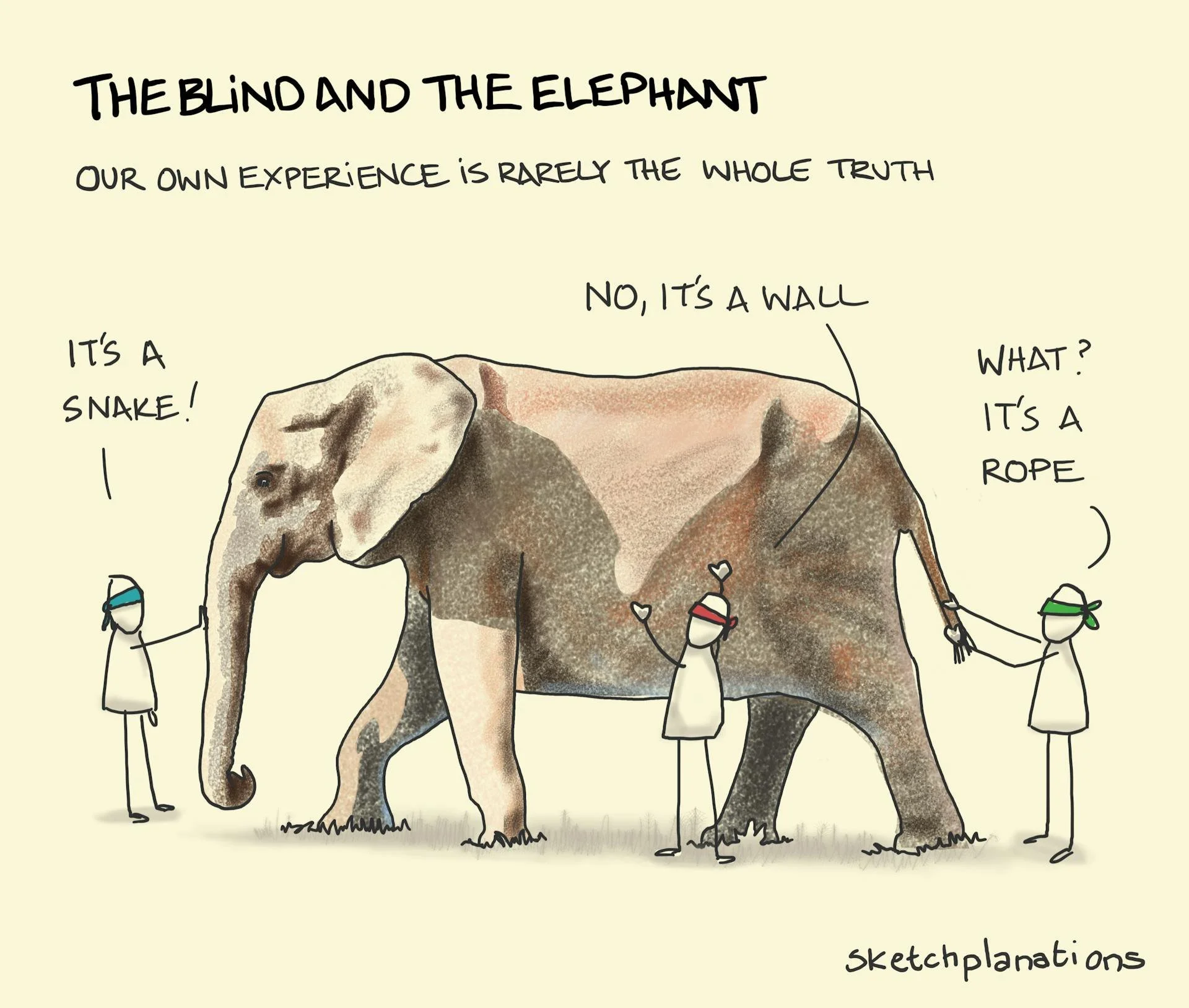
As leaders, it’s easy to forget just how many privileges we hold. Not life privileges, but leadership privileges.
The privilege of seeing across the system.
The privilege of holding more information.
The privilege of hearing multiple viewpoints before forming an opinion.
The privilege of experience.
The privilege of understanding the politics.
The privilege of making decisions rather than having them made for you.
The privilege of power.
That combination is potent. If we’re not careful, it can quietly distort how we see ourselves and others.
When you sit in a leadership seat long enough, perspective can start to feel like superiority. Access can feel like wisdom. Pattern recognition can masquerade as being smarter or better.
What are the blindfolds your team are wearing? Image courtesy of Sketchplanations.
Sometimes leaders forget that their team members don’t hold all of those cards, at least not all at once. They forget that what feels obvious to them has often been weeks, months or even years in the making. They mistake their broader vantage point for personal brilliance, and assume that if something doesn’t feel upsetting or unjust to them, then it simply isn’t.
That doesn’t mean they haven’t earned their position. Many absolutely have. But earning your place of privilege doesn’t remove the privilege itself. It increases your responsibility to hold it well.
When a team member asks a question that feels basic, reacts emotionally to a decision you’ve already processed, or challenges something that feels settled in your mind, it’s worth pausing before judging. Ask yourself whether your response is coming from clarity or from privilege. What context do you have that they don’t? What conversations have you been part of that they haven’t? What information, history or political nuance is shaping your thinking? What emotional distance have you had that they haven’t been afforded? Often what looks like naivety is simply a different vantage point. What feels like overreaction may just be a lack of access to the full picture.
Leadership isn’t about denying privilege. It’s about remembering it exists and using it wisely. The real work is translating what you can see so others aren’t left guessing, bridging the information gaps rather than judging the gaps themselves.
When privilege is held with humility, you create trust. When it’s held without reflection, it risks hardening into a hero complex. That difference changes everything.
Read more about how we support leaders HERE