“It is difficult to think of a single example where a business has suffered as a result of paying too much attention to governance issues.” *
There’s a lot of truth in that.
We’ve all seen what weak governance can do. Unclear decision-making. Inconsistent policies. Compliance gaps. Leaders making it up as they go until the cracks start to show. In those cases, governance is not bureaucracy. It is what turns good intentions into clarity, accountability and sustainability.
A growing business without clear roles or decision rights is one example. What feels flexible at first can quickly become fragile. One poor people decision, one missed risk, one conflict at the top, and the lack of structure suddenly becomes very expensive.
Another is the business that scales faster than its operating discipline. New people arrive, processes get patched together, reporting stays loose, and momentum hides the underlying mess. Eventually customers feel the inconsistency, teams duplicate work, and small issues become big ones. Good governance helps prevent that.
At the same time, more governance is not always better.
Sometimes the problem is not the absence of governance, but governance that has become too controlling, too risk-focused or too disconnected from how work actually happens. When that occurs, the organisation may still look well run from the outside, but underneath it becomes slow, rigid and harder to adapt. This spells trouble for innovation.
Take the organisations banning staff from using LLMs for fear of data breaches. The concern is understandable, but blanket bans often do not stop the behaviour. They just push it underground, onto personal phones and home computers, where there is even less visibility and control. In trying to reduce risk, the business may actually increase it.
Another example is when every idea needs multiple approvals, every exception is treated as dangerous, and every new approach is buried under process before it can be tested. Over time, people stop showing initiative. Innovation shrinks, not because employees do not care, but because the system makes progress harder than caution.
This is why the debate is not governance versus innovation. Businesses need both.
Governance creates boundaries, clarity and protection. Innovation challenges assumptions, tests better ways forward and helps organisations adapt. When risk and governance leaders and innovators work separately, each can become a caricature of itself. One becomes overly restrictive. The other becomes dismissive of real constraints.
The answer is not choosing one over the other. It is designing a relationship where both serve each other.
That means regular communication between the innovators and the operations, risk and governance teams. It means recognising this as a polarity to manage, not a problem to solve once. It means boards understanding that neither side is more important. One protects the organisation from avoidable harm. The other protects it from becoming so controlled that it cannot evolve.
Black and white thinking is what makes governance soar and innovation shrink.
Better governance is not tighter for the sake of it. It is governance designed with human behaviour in mind. Clear enough to protect the business. Flexible enough to support judgement, experimentation and change.
That is where the real value lies.
*Smith, N. (2017), Advising the Family Owned Business, LexisNexis, Bristol, p590
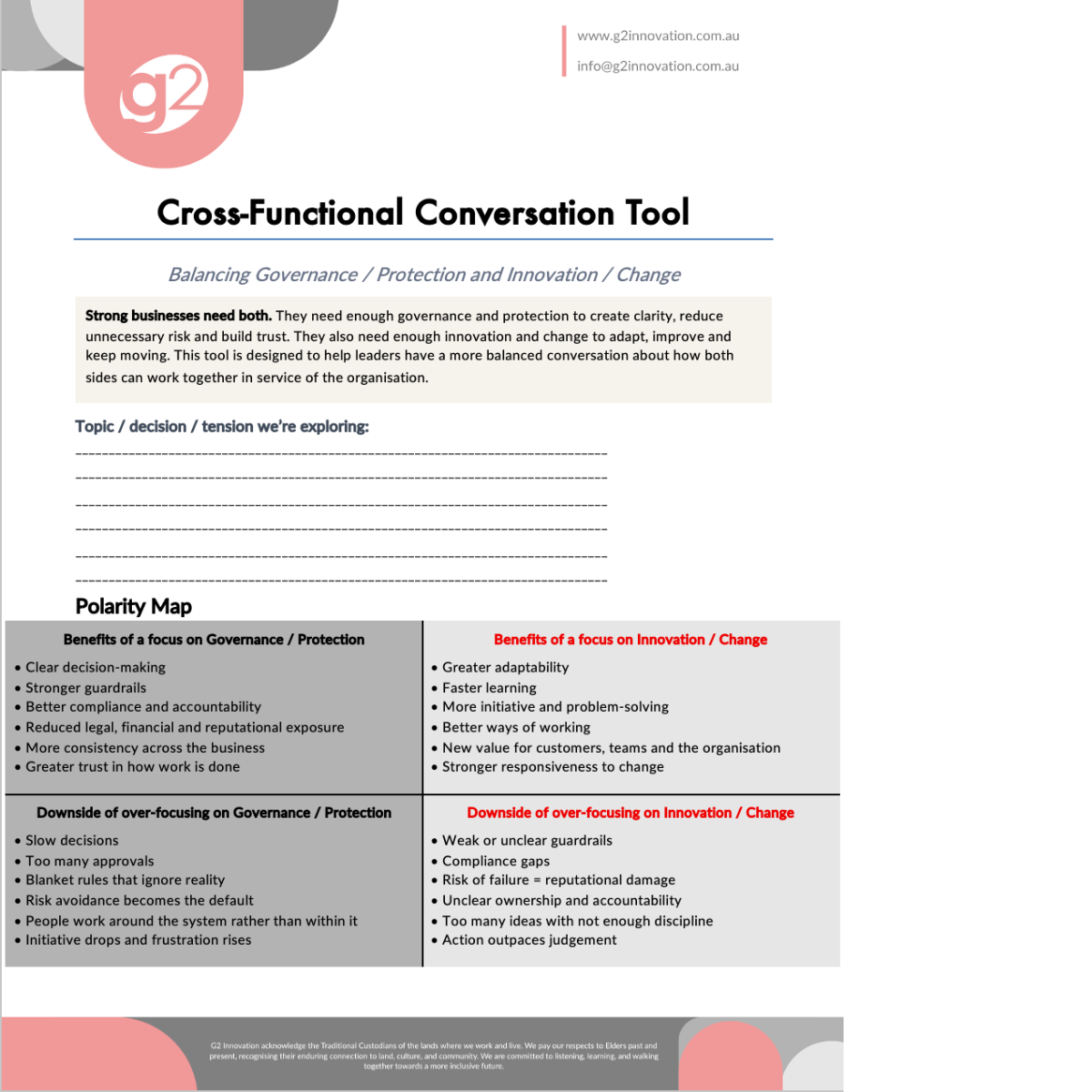
To help ensure you satisfy risk management protocols without inhibiting impact from innovation, we’ve developed a Governance and Innovation Support Template. You can Download by completing your details in the form below.