

Performance has become one of those words that gets thrown around constantly in business.
Boards want it. CEOs are under pressure to improve it. Leaders are asked to lift it. Teams are told to be excellent at it.
Yet for all the focus on performance and productivity, very few organisations are seeing the shift they hoped for. People are working hard. Often harder than ever. Still, the outcomes do not seem to move in proportion to the energy going in.
That is usually the moment organisations double down.
More oversight. More approvals. More meetings. More tracking. More intervention.
It feels sensible. If performance is not where it needs to be, surely tighter management is the answer.
In my experience, it rarely is.
Most performance problems are not effort problems. They are system problems.
When pressure goes up, control usually follows
There is a pattern I see often.
Performance dips, or productivity comes under pressure. Leaders respond by increasing control. That control reduces trust. Reduced trust weakens accountability. Lower accountability then drives poorer performance, which prompts even more control.
Round and round it goes.
It is an understandable loop, but a damaging one.
Control is often treated as the solution. In reality, it is often a symptom that something important is missing in the system.
Something about the way work is set up is creating friction. Something is slowing decisions down, muddying priorities, draining energy or making accountability harder than it should be.
The issue is not that people do not care. The issue is that the system is making good performance harder to achieve.
A useful analogy: traffic lights and roundabouts
One way I explain this is through the difference between traffic lights and roundabouts.
Traffic lights are a control mechanism. They tell people when to stop, when to go, and they remove judgement from the equation. In some situations, they are absolutely necessary.
Roundabouts work differently. They still create order, but they rely more on awareness, judgement and shared accountability. People have to pay attention, read the environment and move in coordination with others.
Most organisations default to traffic lights. Approval layers, rigid handovers, centralised decisions, excessive reporting. Everything is managed through control points.
Some of those controls are important. Many are overused.
When that happens, the system slows down. People stop using judgement. Initiative drops away. Bottlenecks build. Performance suffers, and the response is often to add even more lights.
Performance is an output, not an input
This is the shift I think more leaders need to make.
Performance is not something you directly manage into existence.
Performance is an output.
It is the result of the conditions people are working within. It is shaped by how decisions get made, how clear priorities are, how safe people feel to act, whether teams understand what good looks like, and whether effort can actually flow toward the right things.
The same is true of productivity.
You cannot simply demand it and expect it to appear. You have to design for it.
Look at your business through friction and thrust
When organisations are trying to improve performance, they often focus on adding pressure rather than removing friction.
Yet friction is everywhere.
It shows up in duplicated work, slow approvals, unclear priorities, conflicting instructions, overcomplicated processes, too many projects running at once, and constant stop-start shifts in direction.
Thrust is different. Thrust is what helps work move. Clear priorities. Trust. Decision-making close to the work. A sense of rhythm. Shared ownership. Useful feedback. Consistent leadership.
If you want better performance, one of the best questions you can ask is not “How do we get more from people?”
It is “What in our system is making good performance harder than it needs to be?”
The three conditions that matter most
There are many elements that shape performance, but I keep coming back to three core levers.
Care. Clarity. Consistency.
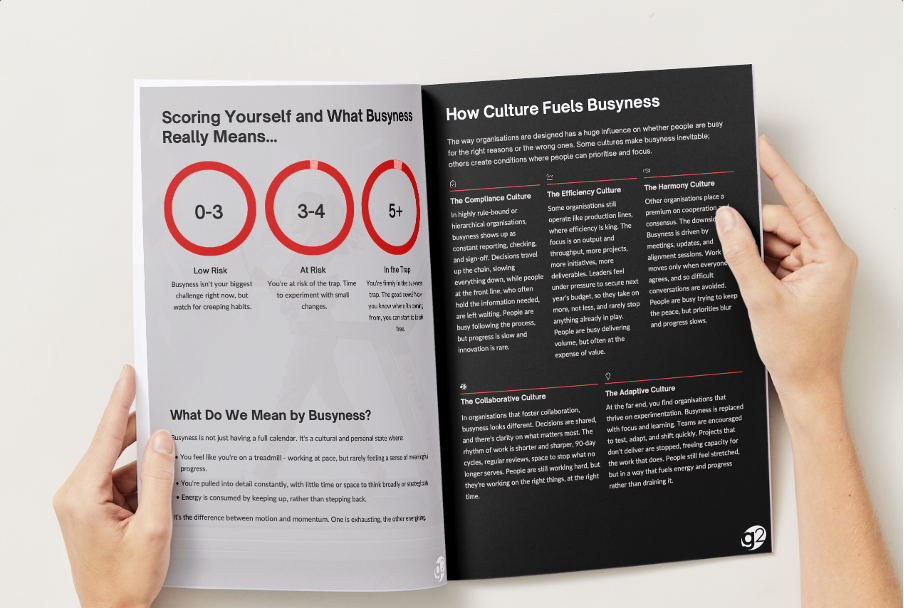
Why are you so busy?
Are you the problem, or is the system the problem?
Download this quick diagnostic and guide to overcoming the Busyness Trap
These are not soft ideas. They are practical conditions for better work.
Care creates trust and energy. When people feel respected, supported and understood, they are far more likely to stay engaged and contribute fully. Without care, people withdraw. They comply, but they do not commit.
Clarity creates direction and speed. It helps people understand what matters, what good looks like and where to focus. Without clarity, teams hesitate, duplicate effort, second guess decisions and lose momentum.
Consistency creates rhythm and compounding progress. It is what turns a good intention into a reliable way of working. Without consistency, everything becomes start-stop. People lose confidence, priorities keep shifting and performance becomes patchy.
When these three conditions are weak, control tends to rush in and fill the gap.
That is why control is so often a symptom. It appears where care, clarity or consistency are missing.
Better performance comes from better design
Once you see performance as a system outcome, the conversation changes.
The question is no longer how to manage people more tightly.
The question becomes how to design a better environment for performance to emerge.
That might mean shorter planning cycles so teams can adjust faster and avoid drift.
It might mean fewer priorities, so effort is not scattered across too many competing demands.
It might mean pushing more decisions to the edge, closer to the people doing the work, instead of funnelling everything upward.
It might mean helping teams shift from “I’ve done my bit” or “they dropped the ball” to a stronger sense of “we own the outcome”.
These are not management tricks. They are design choices.
They shape how work feels, how work flows and how accountability shows up.
Accountability cannot be forced
This is another tension I see in organisations all the time.
Leaders want more accountability, so they apply pressure in the hope that ownership will increase.
Usually, the opposite happens.
People become more cautious. More defensive. More inclined to wait to be told. More likely to focus on protecting themselves instead of progressing the work.
Accountability cannot be enforced in any meaningful or lasting way.
It can, however, be designed for.
When people have the right level of care, clarity and consistency, ownership becomes much more likely. When the system supports good judgement, timely decisions and shared responsibility, accountability stops being something leaders have to drag out of people.
It starts to emerge more naturally.
Innovation depends on this too
This is not just a performance conversation. It is also an innovation conversation.
In many organisations, innovation is treated as an extra. Something people will get to once the real work is done.
The problem is that in poorly designed systems, there is never enough space left over.
When teams are overloaded, over-controlled and bogged down in friction, creativity is one of the first things to disappear.
You do not get innovation by asking for it more loudly.
You get it when the system creates enough space, trust and capacity for it to happen.
What leaders should be asking…
Perhaps the most useful question a leader can ask is this:
What are we currently designing for?
Are we designing for initiative, or dependence?
For judgement, or compliance?
For shared ownership, or upward escalation?
For flow, or friction?
For performance, or the appearance of control?
The answers are often hiding in plain sight.
G2 Innovation can help you design your business for better performance.