
"Success in our first chapter doesn't guarantee success in the next."
It's a deceptively simple statement, made by Canva CEO Melanie Perkins in her announcement of a significant organisational restructure last week. Yet it speaks to one of the greatest barriers to innovation: success itself.
Success has a funny way of making organisations complacent. Strategies, systems and ways of working that once delivered extraordinary results become so deeply embedded that people stop questioning whether they're still fit for purpose. Leaders begin to believe their own rhetoric, celebrate past achievements and overlook the signals suggesting that the world around them has changed.
For Canva, those signals included increasing organisational complexity, changing customer expectations and the rapid advancement of AI. In fact, Perkins acknowledged that Canva's growth has slowed for the first time in a decade. As a result, the company that disrupted an entire industry now faces the challenge of ensuring it doesn't become a victim of disruption itself.
So, they asked themselves an important question.
"What does Canva need to do to succeed in the chapter ahead?"
Take a moment to consider how different that is from asking how to reduce costs, increase efficiencies or protect the business from emerging threats.
One question encourages an organisation to play to win. The others can easily lead to playing not to lose.
According to Perkins, Canva started by considering its future ambitions, then worked backwards to determine the structures, capabilities and ways of working required to achieve them. Only then did it consider the implications for individual roles.
It's an approach that puts strategy at the centre of innovation, rather than simply trying to optimise what already exists. Yet it's not strategy alone that Canva is relying on.
Their approach aligns closely with what G2 Innovation believes are the three foundations of innovation: Strategy, Process and Culture.
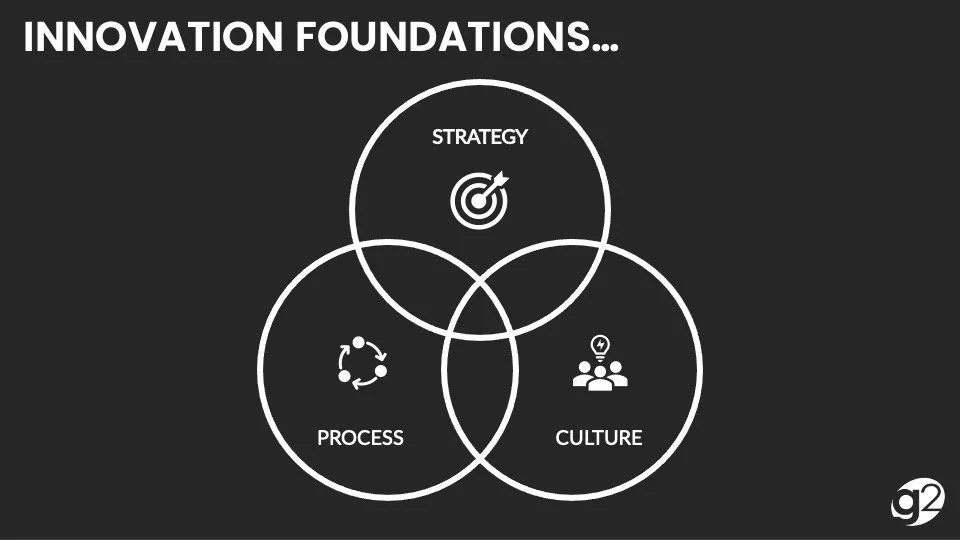
These elements are deeply interconnected, and weaknesses in any one of them can undermine an organisation's ability to innovate. What's particularly interesting about Canva's announcement is how deliberately it appears to address all three.
Strategy: Starting with the future it wants to create, rather than assuming the formula that delivered past success will continue to work.
Process: Challenging the structures, systems and ways of working that have developed over time. Simplifying decision-making, reducing handovers and giving teams greater ownership.
Culture: Recognising the importance of autonomy, collaboration and entrepreneurial thinking, while acknowledging the human consequences of significant organisational change. Perkins' compassionate communication and generous support package for those impacted demonstrate the importance the company places on its people and culture.
All too often, organisations struggling to grow look to their people and their perceived shortcomings for answers. Yet if their strategy is unclear, their processes make action unnecessarily difficult or their culture discourages experimentation, perhaps the problem isn't with their people at all. Perhaps the conditions simply don't exist for those same people to innovate and create growth.
Of course, no one has a crystal ball, and whether Canva's decisions will deliver the intended results remains to be seen. That's the nature of innovation - even the most considered decisions carry risk, and in this case, the human consequences are particularly significant.
Yet there is something worth learning from an organisation prepared to question the very structures and practices that contributed to its success. It's to have the courage to question oneself.
As industries, technologies and expectations continue to evolve, perhaps more leaders need to ask themselves the question Canva has posed:
What does our organisation need to do to succeed in the chapter ahead?
Perhaps the more uncomfortable question is whether they're genuinely prepared to challenge what worked in the last one.