

There’s a moment I see often in organisations where nothing is technically “wrong”, and yet everything starts to feel different.
The people are still capable. The strategy may not have changed. The values are still the same. From the outside, the organisation still looks healthy.
And yet momentum quietly disappears.
Not long ago, I saw this play out in an organisation that had been widely regarded as a great place to work. A respected leader had stepped away, and the next chapter of leadership was not yet clear. In the space between those two moments, something subtle started to happen to the system.
People began treading water.
Projects that once moved quickly started taking longer to gain traction. Innovation slowed. Talent development conversations became less frequent. Rumours about the future began circulating in corners. A quiet undercurrent of uncertainty and discontent started to creep in.
What interested me was that the people themselves hadn’t fundamentally changed. The capability was still there. The care was still there. The intent to perform well was still there.
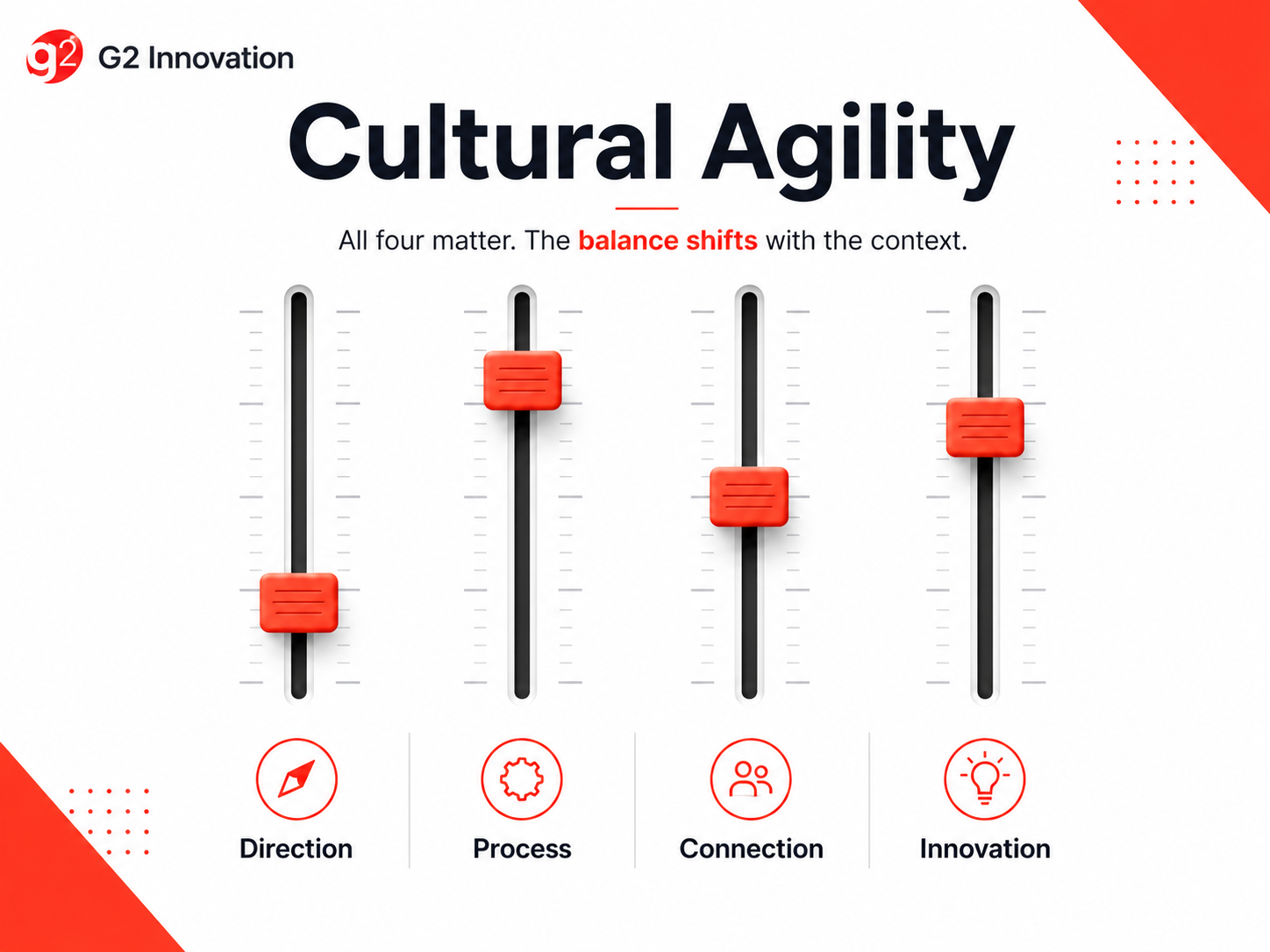
What had changed was the weighting within the cultural system. If we think of culture like a mixing desk, with different cultural drivers creating the full picture, we can see how shifting the volume of any one element can shift the culture, either positively or negatively.
In this organisation, direction had become less visible as people waited for clarity about the future. In response, process started to take up more space. People became more cautious. Decision-making slowed. Innovation became quieter, not because people stopped caring, but because uncertainty changes what feels safe. Connection was still present, but increasingly centred around speculation and reassurance rather than momentum and possibility.
The organisation still contained all the same ingredients that had made it successful. What it lacked was recalibration.
And without recalibration, momentum slowly started to dissipate.
We often talk about culture as though it is fixed. Something an organisation either has or does not have. Something to define, protect and preserve.
In reality, culture is far more fluid than that. It responds constantly to context. A merger, a downturn, rapid growth, a leadership change, public scrutiny or cost pressure can all subtly reshape what behaviours are rewarded, tolerated, avoided or amplified.
That is why I have become increasingly interested in cultural agility, not as a buzzword, but as a leadership capability. At any given point in time, there are usually four forces shaping the culture inside an organisation: direction, process, connection and innovation.
Direction creates clarity and alignment. In moments of uncertainty or pressure, people naturally look upward for certainty. Decisions become more centralised. Speed matters. Alignment matters.
Process creates stability and consistency. This often strengthens during periods of growth, mergers or financial pressure, when organisations need clearer systems, governance and repeatability.
Connection creates trust, belonging and care. During difficult periods, teams often pull closer together and leaders spend more time supporting people emotionally. This can be incredibly important, although when over-relied upon it can also make organisations hesitant to tackle difficult conversations or accountability issues.
Innovation creates movement and adaptability. It pushes people to challenge assumptions, experiment and imagine new possibilities. Organisations often say they want more innovation, particularly during disruption or slowing growth, although innovation becomes difficult to sustain when fear and uncertainty dominate the system.
None of these drivers are inherently good or bad. Healthy organisations need all four.
The difference is in the weighting.
During uncertainty, direction may need to become more visible. During scale, process may need strengthening. During periods of fatigue or loss, connection may need greater attention. During disruption, innovation may need active protection from the gravitational pull of certainty and control.
What fascinates me is that many leaders do not notice these shifts until the effects become visible in performance, engagement or retention data. By then, the signals have usually been present for quite some time.
You can hear them in the language people use.
“We’re waiting to see what happens.”
“Everything feels slower at the moment.”
“I’m not sure who’s making decisions.”
“We need to be careful.”
“That’s probably above my pay grade.”
Signals like these tell us something important about what is currently driving the culture and whether the system is still calibrated for the environment it is operating within.
This is where awareness becomes essential.
Awareness is what enables agility.
When leaders can see what is happening in the system, and when they are willing to talk about it openly, change starts to happen despite the uncertainty around them. People stop simply reacting to the conditions they are in, and start making more deliberate choices about what the moment requires.
The role of leadership is not to choose one culture and defend it relentlessly. It is to notice the signals emerging in the system and consciously shape the response, so that what is needed in each moment is what gets activated.
That is cultural agility.
Not a fixed culture, perfectly preserved.
A living system, paying attention.